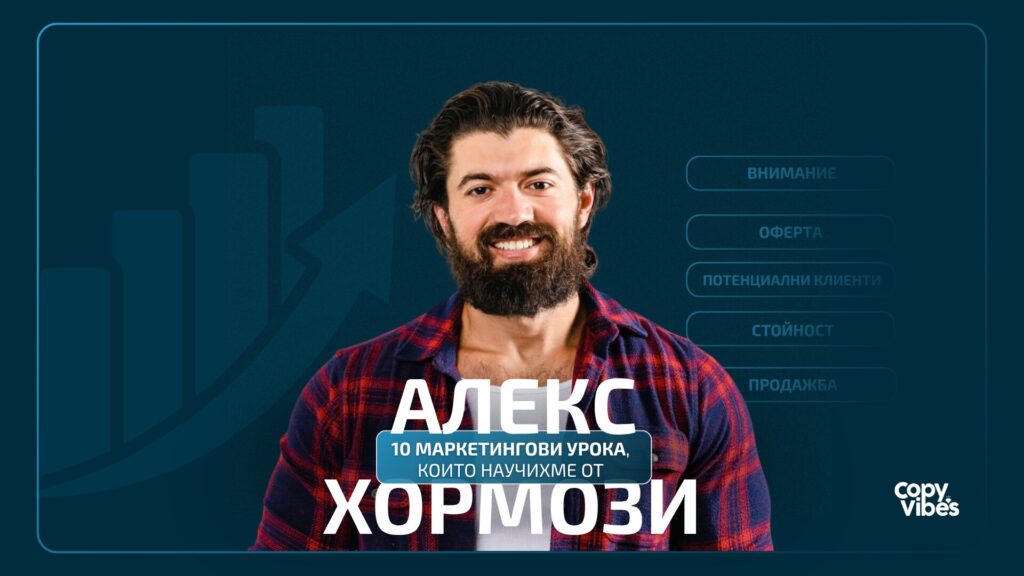
It's enough to spend no more than 10-20 minutes on social media or YouTube consuming content about business and entrepreneurship to come across the name Alex Hormozi at least once. CEO of the holding company Acquisition , which he runs with his wife Leila, Hormozi is among the most famous motivators and creators of content about entrepreneurship in online circles.
Hormozi's content is characterized by the fact that he delivers it without wearing expensive designer suits (often a tank top and a casual shirt/sweatshirt are enough), without flooding you with long-standing clichés, and without overacting. On the contrary, he knows how to break things through his own prism, sharing with you his personal views on business, not someone else's. He is direct and brutally honest, without sugarcoating what he wants to tell you.
We offer you 10 truths from Alex Hormozi about marketing and sales that we think you will find interesting to read:
1. Don't sell the product, but the value/result
One of the main ideas in Alex Hormozi's approach is that the customer never buys the product or service itself. He buys the value or feeling he expects to get by doing so.
For example, a fitness trainer doesn't just sell personal training. The client buys better physical shape from him, which in turn will allow him to feel more confident in his own skin.
Similarly, a marketing agency doesn't sell "social media management," but things like visibility, inquiries, customers, and sales.
This fundamentally changes the way we communicate our product or service.
We are talking about the value we bring to the customer , not about the characteristics of the service.
2. A strong offer changes all marketing
Alex Hormozi often puts the offer itself at the center of the marketing system. The idea is quite simple – if your offer is not completely clear or does not bring enough value, advertising and sales will remain at a low level.
In other words, we don't say " Our product costs 500 euros ," but we think about how to do the following: " What can I include/remove, add, or structure so that the customer sees much more value in the offering? "
Here, things like bonuses, guarantees, a better and easier process, additional service, a clearer end result, etc. come to the fore.
However, the goal is not to simply add more things “on the fly.” The goal is for the customer to feel that the perceived value is much higher than the price we have offered them .
3. Value is related to desire, probability of success, time, and effort
Alex Hormozi is known for his idea that value has a certain framework by which we can be guided.
Explained most simply, it considers value as a function of four factors:
Desired outcome × Perceived probability of success
divided by:
Time to achieve the result × Effort and sacrifices
Here are four important marketing questions:
- How to make the result more desirable?
- How do we increase confidence that the client will achieve it?
- How to shorten the time to results?
- How to reduce the effort required on the customer's part?
This is much more useful than simply thinking “we need to reduce the price”.
Sometimes the customer doesn't need a cheaper product. They need a safer, faster, and easier path to the desired result .
4. Being specific sells better than general promises
There are probably a lot of marketing agencies that use slogans like “We help your business grow.” That sounds good, but the truth is that it says almost nothing.
It’s much more specific, for example, to say: “We help dental clinics generate more booked consultations through Meta ads.” Don’t you think so?
Being specific helps customers recognize themselves and their own needs in the message we send them.
The better we understand:
- who is the client;
- what is the problem;
- what he wants to achieve;
- what he has already tried;
- what's stopping him;
the more specifically we can build our marketing message.
Good communication doesn't try to speak to everyone .
She drives. the right person to say to themselves: “This is right for me.
5. Don't rely on just one channel to attract customers
One of Hormozi's favorite topics is how to attract new customers and what channels to use to do so.
Businesses can use various channels for this purpose, including:
- content creation;
- social networks;
- advertisements;
- partnerships;
- recommendations;
- direct contact;
- email marketing;
- events;
- organic search;
It's no lie that in the beginning it's probably better to focus on one channel, trying to develop it really well, putting all our efforts into it. However, in the long run, relying on just one channel to attract customers can create some risk for the future of the business.
Let's put it this way: if our entire business depends on one algorithm, one advertising platform, or one person, any change or disruption can become a serious problem.
Sustainable marketing gradually builds a portfolio of channels that serve it well and are not dependent on each other. If one “falls”, another will remain in place.
6. More value does not mean lower price
When sales are weak, the natural reaction of many businesses is to reduce the price of their service.
This is not always the right answer.
If the customer doesn't see enough value, a 20% discount might just make an under-attractive offer a little cheaper.
The better question is:
“How can I make the offer even more valuable and irresistible?”
We can add:
- better service;
- a clearer process;
- guarantee;
- training;
- additional resources;
- faster delivery;
- personalization;
- follow-up support;
So instead of engaging in a price war, we work on value .
7. Trust is part of marketing
The bigger the promise, the more important it is to show why the customer should believe us.
Here they come:
- case studies;
- client results;
- recommendations;
- demonstrations;
- specific examples;
- statistics;
- content;
- expertise;
- transparency about the process;
Saying “we are the best” is not very convincing.
Showing what you did, for whom, and what the result was is much more powerful.
In this sense, evidence of results is not just an element of sales. It is part of the offer itself.
8. Marketing doesn't end when you get the customer
Attracting a client is just the beginning.
A business can invest heavily in advertising to get the first sale, but then do almost nothing to retain the customer.
This is missing a huge opportunity.
After the first purchase, the following may follow:
- additional products;
- higher class services;
- subscription;
- maintenance;
- repeat purchase;
- recommendation to another client.
This increases the total value of a customer to the business.
Therefore, good marketing doesn't just ask:
“How do I get a new client?”
He also asks:
“How do I provide such good value that the customer wants to stay with me?”
9. Content is a way to build trust before selling
One of the easiest ways to demonstrate expertise is through content.
It can be:
- educational;
- practical;
- analytical;
- entertaining;
- based on personal experience;
- aimed at a specific problem;
Instead of constantly saying:
“Buy from us.”
we can create content that shows:
“Here’s how I understand your problem and here’s how you can solve it.”
This way, the potential customer receives value even before they buy.
According to Alex Hormozi, this is what makes content a powerful marketing tool – it can turn a stranger into someone who already has a certain level of trust in the brand.
10. Marketing should be measured, not just felt
The last lesson is perhaps one of the most important.
“This ad looks good” is not a sufficient argument.
“This post got a lot of likes” also doesn’t automatically mean that the marketing is working.
We need to know what is happening along the chain:
Attention → potential customer → conversation/inquiry → sale → repeat purchase → recommendation
And to measure the indicators that are important for the business.
For example:
- customer acquisition cost;
- conversion rate;
- average purchase value;
- repeat purchase rate;
- customer value over time;
- return on advertising costs.
When marketing becomes a system of measurable processes, decisions can be based more on data and less on feelings.
In conclusion
The most interesting thing about Alex Hormozi's approach is that many of his ideas are actually extremely simple.
Create a strong offer.
Understand the customer.
Communicate a specific result.
Increase perceived value.
Build trust.
Constantly generate potential customers.
Measure the results.
The real challenge is not to learn these principles, but to apply them consistently.
Because good marketing is not just about getting someone to pay attention.
It's about showing the right person why your solution matters to their problem – and giving them enough reason to take the next step.