Artificial intelligence has always been a big part of the technology sector. AI and machine learning (ML) are increasingly becoming a part of people's everyday lives. They allow companies to achieve desired results with less time and money, make important decisions quickly, and create new products and services .
AI and machine learning technologies have seen a huge boost in development over the past year, leading to several major breakthroughs. Let's try to understand what the key AI trends were in 2023 and what lies ahead.
[ez-toc]
The (Un)expected Rise of AI: Causes and Consequences
AI and ML technologies are expected to grow by 35% by 2026, with the overall technology now valued at almost $10 billion.
COVID-19 has stimulated the active development of many digital industries and led to a surge in online shopping. The reason is that many people have switched to online platforms to make various purchases. At many points, online stores were even the only accessible and convenient channels for trading. The changes have provided an opportunity for sellers and large consumer goods companies to take the initiative in developing the area intertwined with digitalization.
With the help of artificial intelligence, it is possible to quickly make workable decisions in the following areas of business:
- marketing;
- e-commerce;
- product management.
Implementation of ideas
This will allow many of the ideas that otherwise sound far-fetched to be realized. According to the US Department of Commerce, retail sales in 2023 reached a turnover of nearly $6 trillion.
Machine learning techniques are commonly used to “train” artificial intelligence. When it comes to commerce and retail, these technologies help users get a personalized experience and an interactive environment to complete tasks.
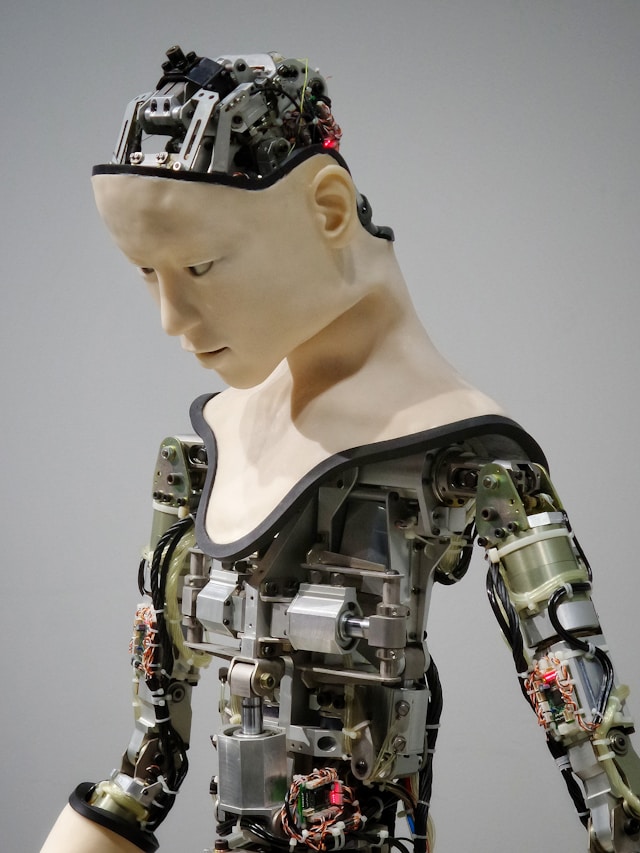
Growth in production
According to a study by IBM (International Business Machines – the world’s largest provider of software and complex IT services), the integration of artificial intelligence in trade and manufacturing will increase from 40% to 80% within 3 years. In addition, the technology enjoys constant investment, which provides an opportunity for improvement and development.
Only the possible reluctance of some large corporations to introduce more innovations would slow down the overall growth of the market. Another problem for the development of the trend in 2024 is likely to be the shortage of qualified employees who know how to implement AI in business.
Key market trends in artificial intelligence for 2024
Experts are confident that in the near future, the field of product optimization will begin to occupy a significant share of the labor market. With the development of big data analysis, the implementation of AI-enabled devices and programs will be increasingly widespread.
Technologies that work with artificial intelligence on huge databases, including machine learning, are already available. Among them are:
- Human speech processing;
- Deep learning;
- Programs for automated decision making.
New artificial intelligence technologies are yet to unleash their potential for work and the many benefits of integrating them into retail. Among the advantages are:
- cost savings;
- high performance;
- quick decision-making to address business problems;
- fast delivery of goods;
- the development of innovations (intelligent bots, autonomous vehicles).
The benefits described are expected to improve the analytical and behavioral experience of users, thereby increasing the importance of optimization.
Baker Hughes
In 2020, Baker Hughes launched an AI-powered application that allowed operators to see real-time production data from oil wells. This led to much more accurate forecasts of oil and gas prices and production, becoming a shining example of the potential that AI has to have a huge, direct impact on businesses worldwide.
Significant growth in North America
North America is likely to dominate the AI market over the next few years, as it is the most active region in the adoption of AI technologies. This is largely due to the large-scale high-tech industrialization in the US and Canada. They are directing their investments towards modernizing the retail industry and addressing specific challenges in this area.
Both countries were among the first to introduce AI to optimize goods and services in the aforementioned sector. Thanks to innovations, it is easier for retailers to support the end user, manage their business and understand buying patterns and customer preferences.

Leading brands that are already using artificial intelligence
Naturally, artificial intelligence is being integrated into offline and online stores to increase sales while reducing costs. This has already been done by leading technology companies such as:
- NVIDIA;
- Intel;
- Salesforce;
- Sentient Technologies;
- Microsoft;
- Google;
- IBM;
- Amazon Web Services.
Already in 2020, the active use of AI in various areas began. Kenco Logistics launched DaVinci AI. This product provides a wide range of analytical services covering all supply chains. The technology can be used to obtain predictive information, which can later be turned into actions. Mastercard introduced Drive Through solutions for merchants that simplify in-store shopping, working with minimal contact and maximum engagement of parties.
Leading trends in artificial intelligence
Now let's take a look at the biggest trends in artificial intelligence and machine learning in 2023. They will give you ideas on how to control business and other areas of activity.
Hyperautomation
Hyperautomation refers to the processes of implementing innovative developments to speed up and simplify tasks with minimal use of human power and knowledge. This concept is often called digital or intellectual automation.
Many leading companies have to work with large flows of information and automation is needed to extract it effectively. Data literacy and data analysis can be found everywhere, so these tools are becoming increasingly accessible and desirable these days. Professions that will be in high demand in this field are:
- application architect;
- machine learning specialist;
- data engineer.
Types of automation
Data science is suitable for financial institutions, manufacturing, insurance companies, marketing firms, etc. Hyperautomation is necessary to conduct research in order to increase the company's profit. The main modern technologies here are:
- process automation using bots (RPA);
- Working with AI and ML;
- Cognitive process automation;
- Software for proper process management (iBPMS).
The goal set for these technologies is to simplify design processes so that they can be carried out with minimal human intervention.

Significant performance improvement
The specific methods of hyperautomation in a company vary. For example, conversational AI and RPA can be used to improve customer service. This will help automate email responses to customers, as well as improve their CSAT satisfaction.
Increasing employee productivity in a company can be achieved by incorporating technology into labor-intensive processes. This implementation reduces technical work and improves focus and motivation on performing other tasks. The use of system integrations will give any company the opportunity to optimize its work and business results.
Cybersecurity applications
One of the important components of the modern world is information security. AI and ML enable the creation of reliable and automated cyber defense.
The main methods for improving cybersecurity using machine learning and artificial intelligence are based on the fact that AI helps filter, classify, and process incoming information. It is no secret that the volume of data in this area is truly enormous.
ML, in turn, enables the analysis of all this data. To help proactive protection, it provides timely indications of threats or malware.
Systematization of information
The implementation of the technology will systematize information according to set parameters, allowing it to be compared and any threats to be tracked.
AI will simplify auditing your information security practices, allowing you to quickly learn about the effectiveness of your restrictions. This way:
- AL and ML quickly detect threats and malware, creating a security platform for scanning large amounts of information;
- With the help of AI in 2024, enterprises are strengthening methods for the so-called cloud migration, by improving the work with large amounts of data;
- The structure, assets, and end users of a company are protected.
Intersection of AI and ML with IoT
AI and ML are undoubtedly improving security and user experience on the internet. Gartner published a study according to which by the end of 2022, over 80% of projects for the high-profile Internet of Things (IoT) in corporations will inevitably include AI and ML. However, all devices must be connected to the Internet to be able to respond to any situation in a timely manner based on the information provided.
Easier information collection
In the described model, the importance of innovation lies in the ability to quickly acquire information to determine patterns and detect anomalies. All this is done with the help of intelligent sensors and additional devices. This data even includes objective physical quantities such as:
- temperature;
- pressure;
- humidity;
- air cleanliness;
- sound changes;
- vision recognition.
Smart home
The intersection of AI, ML, and IoT can be found in the smart home, around the modern city, or in wearable devices. The latter include smartwatches, bracelets, health monitoring apps, etc. This includes AR/VR devices and wireless headsets.
Implementation in a smart home will allow for automatic control of lighting, temperature, and electrical appliances. Moreover, such an innovation not only does everything automatically, but also adapts to the habits of its inhabitants, which adds more support for users.
AIoT for smart cities
AIoT is also used in smart cities, creating a comfortable environment. The technology monitors the order, safety and comfort of residents. Developments are added to smart transport, lighting or the energy system. In industry, AI and machine learning simplify the analysis of information that is needed to optimize all activities, including supply chains and logistics.

Business forecasting and analysis
Compared to the methods described above, forecasting and analysis in business using AI is the easiest thing to do. AI and ML offer forecasting with an accuracy of up to 99%. Today, financial companies are already using technology to know the demand for currency pairs based on market conditions and show people’s behavior, as well as volatility levels in real time. This makes it possible to provide the financial and technical sectors with the right amount of supply to match demand.
The rise of augmented intelligence
An interesting trend is the combination of natural and artificial intelligence, through which AI and humans can significantly increase cognitive productivity.
According to Gartner, by 2023, 40% of infrastructure and operations teams will start using AI-powered automation to achieve greater IT productivity. As a result, half of the complex work will be done by machines.
With the help of augmented intelligence, various platforms quickly collect information and structure it through templates. Data is taken from various sources and the company gets a complete picture of the product, its customer, etc.
This trend in artificial intelligence will be key and will develop rapidly in 2024 in sectors such as financial services, healthcare, travel and commerce.
IT trends you shouldn't expect in 2024
According to ABI Research analysts, there are several trends that could shape the technology market, as well as trends that are attracting a lot of attention, investment, but are less likely to impact the market in 2024.
Final calculations
Analysts suggest that there will be no edge computing boom, but will only continue with a gradual increase. The methods of using edge computing and financial dependence are directly related to the 5G network in both the private and public sectors. The price loyalty of these services for the development of edge computing has not yet passed into the global phase of reality. Therefore, the overall development is planned to be slower than expected.
Robotics
Nor will companion robots become widespread. For many years, leading developers and companies were forced to abandon the commercialization of such a service. It was only in 2021 that investment in such a sector began to flow again, and then the potential of AI-powered technologies was reconsidered.
Amazon's Astro robot has generated great interest, but despite its potential, it is unlikely to make the breakthrough expected by analysts and industry experts in 2024.
Sales
The next trend that is unlikely to happen in 2023 is a recovery in car sales. Supply chains are still struggling to keep up with demand due to a shortage of semiconductors. The US is actively moving in this direction, but there is no quick fix for the problem yet. ABI Research does not expect new car sales to return to $90 million before mid- to late-2024.
Shortage of semiconductors
As mentioned, the semiconductor shortage will continue to be addressed in 2024. The main challenges are related to additional capacity, inflationary effects and real demand. The main risks are in the social and political aspects, as a result of which there is no possibility of timely launch of new production capacity.
Language models
AI programs are being actively created in the areas of language, machine-assisted communication, and machine vision. The costs of providing these technologies and services for them are growing faster than the costs of software, and this trend may continue throughout 2024.
In conclusion
To summarize: according to an IDC study, global spending on artificial intelligence development in 2024 could exceed $500 billion. The main focus is currently on creating technologies and implementing them in business projects to improve logistics, technological processes, and planning.
All of the AI trends described above are emerging gradually and will continue to develop steadily. Other features that can be implemented and added include machine learning in voice services and support, and digital information regulation.
AI and ML help large companies and traders understand market sentiment, stress levels, and other factors that work together to make quick decisions. Artificial intelligence and machine learning are yet to play a major role in managing complex tasks for the success of any business.
Robotization of processes shows impeccable results, eliminating human errors. The active and large-scale development of industrial areas further increases the need for developments in the field of artificial intelligence and machine learning.